

Emma Skipper: Confessions Of A Facilitator
Name: Emma Skipper
Location at time of writing: Wells, UK

A bit about me:
I’m a nature-loving facilitator, children’s book author and DIY nerd. I love anything green and spend most of my time (when not facilitating) building things, growing plants veg on my allotment or imagining new lands and mythical creatures for my fantasy novels. My work is rooted in a simple belief: the right conditions (the right space, the right questions, the right people) unlock something no single person can achieve alone. And this conviction started early…
Growing up on a farm with the freedom to roam and embark on my own adventures, I learned that curiosity flourishes when you're given room to explore and imagine. This is as much the case for a workshop environment, as it is for my fantasy novels. I aspire to help encourage people to see that creativity, adventure and opportunity are not the privilege of the few, but are available for us all to leverage if we’re provided the right space, stimulus and tools.
I didn't expect facilitation to teach me…
In a world that rarely stops, I’ve learned that the ‘workshop’ itself is an act of resistance.
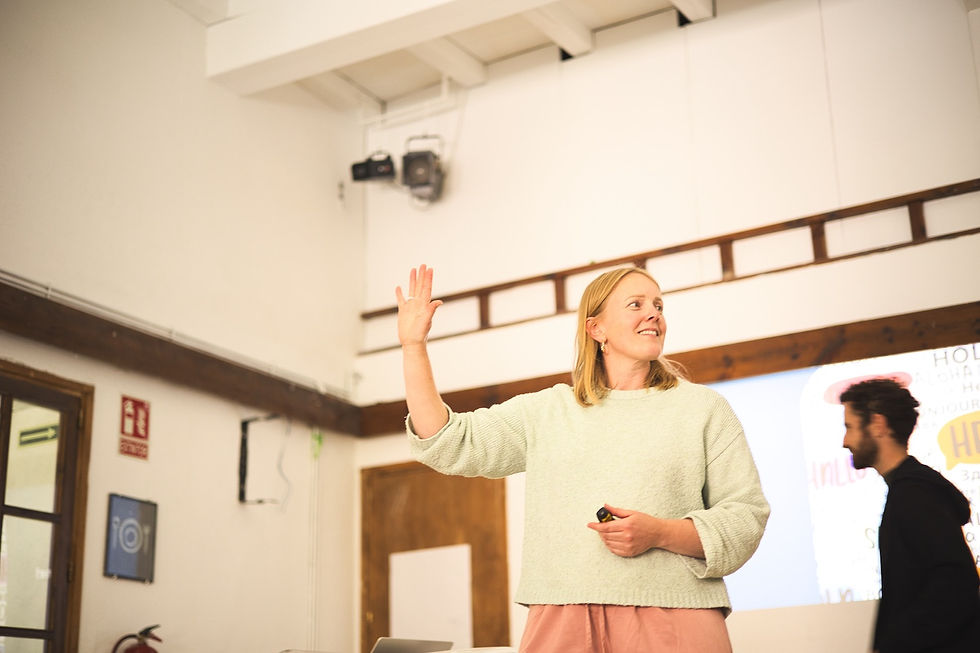
The extraordinary practitioners, scientists and changemakers I have the pleasure of working with are navigating some of the most pressing environmental and social challenges of our time; often under-resourced, overstretched, and pulled in every direction. The workshop space offers something increasingly rare: a chance to pause, collaborate and embrace what emerges. They help forge new pathways; both for ideas and for communities. It’s a stark reminder that the hardest problems don't yield to urgency alone… and that perhaps our only chance to overcome the stickiest of challenges, might be to invest in these spaces and conversations, together.
In my part of the world…
In the UK, no problem is too great, or too complex, that it cannot be solved over a cup of tea. The type of tea is important too. English breakfast is preferable (although I’d take an Earl Grey with a slice of lemon too!) and a dash of milk crucial (but not too much).

The Brits could talk about tea for decades. How they take it. What to have with it (a custard cream biscuit please). The list goes on…
In all seriousness though, the act of sharing a drink, or food, over a table with someone is a sacred thing. It forces a conversation. It forces you to listen. In turn, this forges bonds between people and place, fundamentally increasing the resilience of communities.
So yes, we all must drink more tea.
One time, everything went sideways…
I’ve seen it time and time again. Trying to put too much in an agenda always goes sideways. The same goes for not honouring participants with good breaks (and good coffee). Sensemaking is a huge part of the process and I’ve learnt the hard way that if you don’t give people that time to decompress and process together, the output, outcomes and impact will always suffer.
My weirdest / most wonderful tool is…
I recently used a tool called ‘Reversals’ as an energiser. I wanted to prime the group to be prepared to challenge their assumptions later in the day. Just teaching this felt too serious and low energy though. Not my style.

The image I used as stimulus was designed to be disarming; a bit weird, a bit meta. They had to list all the things they knew, or believed to be true, about the situation. After they’d done this, they had to reverse each point to it’s opposite.
The result? Most were bizarre and ridiculous. However a few of them felt genuinely possible and surprising. This is important because the image didn't change; their assumptions did. And the moment an assumption flips from 'obvious truth' to 'hmmm, just perhaps!' is the moment new opportunities appear.
It really did land so well as a result. Using the ‘random’ image to help them break free of their challenge space, helped them think further outside the box. This in turn forced them to challenge their assumptions AND digest the theory so that they were able to apply it more concretely later that day.
If I could change one thing about how we work together on this planet…

Bring back dancehalls. I’m serious.
Societies are becoming increasingly technology-enabled; our experiences often lived through screens more than the real world. Despite the human race being more connected than ever, it feels we’re moving faster and faster towards isolation. And you see this at every level; from the anxious teenager with a social media addiction to our ever-polarised politics.
I speak for the UK here (yet I hear signals from elsewhere as well) that, set against this backdrop, is a drop in funding and investment for local community and cultural spaces too. Spaces that used to bring people together, allow couples to meet, families to get support, people to collaborate, challenge and deliberate. In losing these spaces, I feel we’ve forgotten what it actually feels like to be in the physical presence of people unlike you. The real-life, somatic experience of sensing and exploring how your body, and your actions, feel within space, rather than as observers of it through screens.
Dancehalls showcase the sharp edge of this. A collective experience of art, culture and community. Spaces where people used to experience the stimulus of creative output and have to use their interpretation and intitution to process that energy; for themselves, and those around them.
Anyway, don’t we all deserve a little more joy?
Question from Lydia:
Who or what has influenced your facilitation journey the most?
Discovering Creative Problem Solving (CPS) for the first time was transformative for me. It managed to provide a simple and comprehensive framework to lay over my own intuitions around how and why I create, as well as where I struggle and don't get energy. Having come from a pretty toxic working environment where we'd often be told we either good or bad at something, a thinker or a doer (and somehow a doer was implied to be less important), this framework and the accompanying Foursight model have fundamentally changed how I work, how I can appreciate my work, and how I can best collaborate with others in a way that brings the best of all of us to the floor.
“Pass It On”
I’d like to pass it on to Tee. My question is... How does music turn up in your work?


Comments