

Reconnecting a community of practice: facilitating Patagonia’s Partner Stores & Shop-in-Shop gathering
In April 2026, Patagonia France brought together its Partner Stores and Shop-in-Shop partners for two days of exchange, learning and collaboration. Partner Stores are independent retailers that are part of Patagonia’s authorised dealer network, while Shop-in-Shop partners host a dedicated Patagonia retail space within their own store. Together, they form an important part of Patagonia’s retail ecosystem in France.
The gathering was an opportunity to bring this community together in person again after some time apart. But it was also an opportunity to rethink what this kind of gathering could look like. Rather than relying entirely on a traditional sequence of presentations followed by questions, Patagonia wanted to create more space for interaction, discussion and shared learning.
Vincent, facilitator at Inclusive Innovation, worked with the Patagonia team across the two-day event to design and facilitate a more participatory approach.

From presentations to participation
The programme combined three complementary elements: business and market updates from Patagonia, product and marketing information, and interactive workshops.
Some moments naturally called for Patagonia to share information: updates on the market and business, new product ranges, marketing campaigns and B2B processes. But these moments were deliberately interspersed with opportunities for participants to react, ask questions and connect the information with their own experiences in stores.
This helped shift the dynamic away from a purely top-down format. Instead of simply receiving information, participants were invited to bring their own observations from the field into the conversation.
This was particularly important because the people in the room had a wealth of experience to share. They see customers every day, observe changing market conditions first-hand and have developed their own ways of presenting, selling and talking about Patagonia’s products and environmental commitments.
The question was therefore not simply: “What does Patagonia need to tell its partners?” It was also: “What can Patagonia learn from its partners, and what can the partners learn from each other?”
Rebuilding a community of practice
One of the ideas that shaped the facilitation approach was that a community of practice exists, at least in part, because people want to learn from one another: to exchange experiences, build confidence, solve shared challenges and feel connected to others doing similar work.
For dispersed practitioners, this connection can be particularly valuable. A shop owner or retail team can sometimes feel like they are navigating challenges on their own. Bringing them together creates a sense that they are part of something larger.
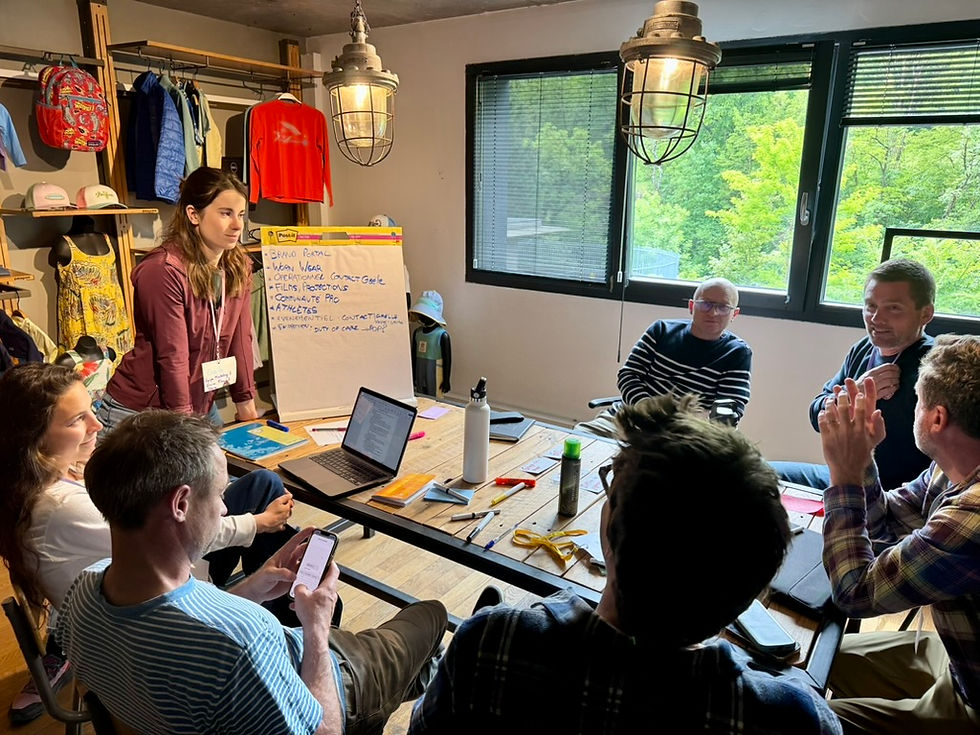
This meant that the atmosphere of the gathering mattered as much as the agenda. The aim was to create something closer to a cafeteria than a conference room: a space where people could meet, talk, compare experiences and discover that others are facing many of the same questions.
The opening activity –involving a roll of toilet paper– helped establish this atmosphere from the start. Over the course of the two days, participants gradually became more comfortable with one another, and the quality and openness of the exchanges grew with it.
The presence of the Patagonia team was also important. Patagonia colleagues were visible and engaged throughout the gathering, creating a sense that the event was something being built together rather than something being delivered to the partners.
Learning from the network
The second day moved increasingly towards peer exchange.
Participants worked in groups around marketing and merchandising, discussing how they approached these topics in their own stores and sharing practices and challenges. These sessions created opportunities for participants to compare experiences across different retail contexts rather than simply receiving another set of recommendations.
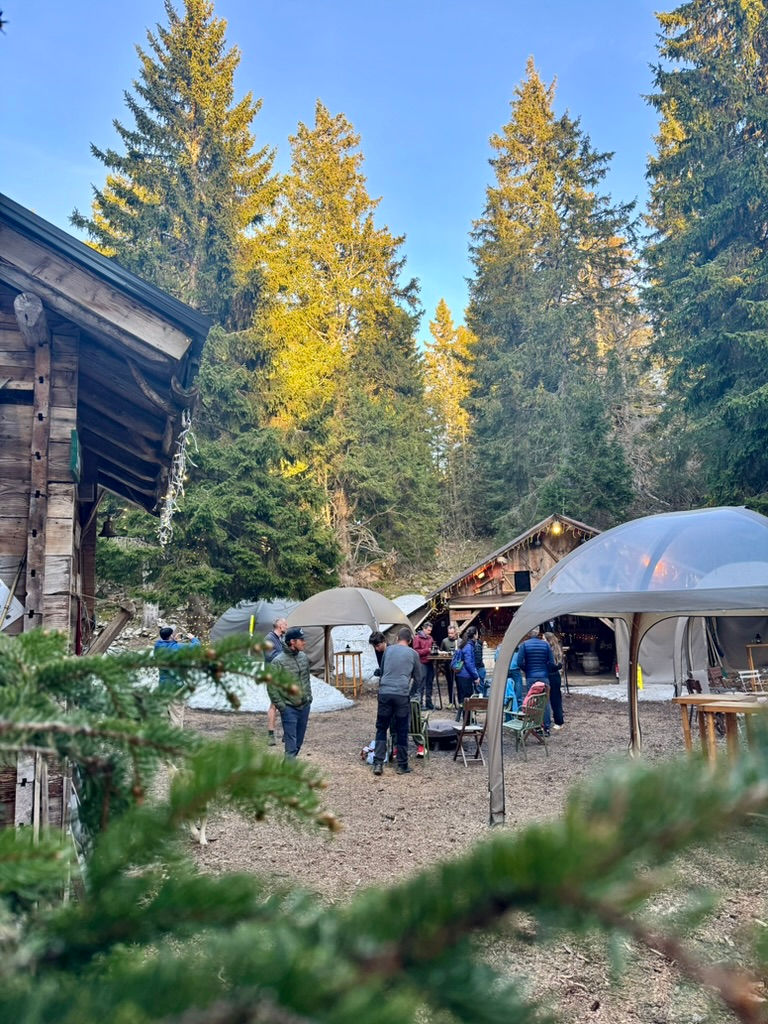
The programme also included an evening at Semnoz Mountain, where participants spent time outdoors, hiking and learning with a local guide before sharing a typical Savoyard dinner at an eco-designed base camp. The evening also provided an opportunity to hear more about Patagonia’s environmental initiatives, including 1% for the Planet. Beyond the retail and business agenda, it offered a more experiential way to connect with the environmental values at the heart of Patagonia’s identity.
Across the two days, the different formats created a useful balance between information, conversation and practice.
The preparation behind the scenes was equally important. Careful planning with the Patagonia team meant that the programme could move smoothly between different speakers, formats and locations while keeping to the schedule.
What we learned
The gathering showed the value of combining moments of expert input with opportunities for participants to make sense of that input together.
The approach worked particularly well when presentations were followed by discussion and when participants had a clear reason to contribute their own experience. The workshops were especially successful, creating a different kind of energy from the more traditional information-sharing sessions.
There is also an opportunity to push the peer-learning dimension further in future editions.
Rather than only creating space for participants to react to Patagonia’s agenda, future gatherings could invite partners to bring their own questions and challenges to the table. This could include peer-consulting sessions around specific challenges, World Café conversations around shared questions, or an Open Space where participants propose the topics they most want to explore.
A space to reconnect, learn and belong
Ultimately, the two days were about more than sharing information about Patagonia’s business, products or upcoming campaigns. They were about bringing a dispersed network back together and creating the conditions for people to reconnect with each other, with the Patagonia team and with the values that bring them together.
As the Patagonia team reflected afterwards, the event left participants with a sense of having achieved a lot while still feeling authentic and true to the Patagonia brand. It also helped participants better understand the “DNA” of Patagonia, while giving everyone space to contribute.
For Inclusive Innovation, it was a useful reminder that the right agenda is only part of the equation. When a group already contains knowledge, experience and relationships, good facilitation can help bring those resources to the surface.
The goal is not simply to make a meeting more interactive. It is to create the conditions for a community to learn with and from itself.
It was my first time organizing this workshop at Patagonia, and also my first time working with Vincent, and it turned out to be a great success! Vincent supported us from the very beginning, helping us brainstorm and structure our ideas, then guiding us through the content in a very efficient and smooth way. On the D-day, he played a key role in creating natural connections, encouraging collaboration, and facilitating productive discussions. The good energy, both in and out of the meeting room was mentioned by all participants, it was a perfect mix of work, laughter and learning. All wrapped in authenticity and good vibes! A huge thanks to Vincent and the Inclusive Innovation team for your support and partnership throughout this project!
Laura Billod-Morel – Country Sales Manager FR

Comments