

When the answer isn’t another initiative: building alignment for food systems transformation in Asia
Updated: Jun 2
Food systems transformation is one of those challenges everyone agrees is urgent, and few would describe as simple.
Across Asia, researchers, policymakers, farmers’ organizations, civil society leaders, youth advocates, and funders are all working toward healthier, more resilient, and more equitable food systems. Yet progress often remains fragmented, with actors pursuing similar goals from disconnected parts of the system.
That was the context for a three-day regional workshop in Chon Buri, Thailand, convened by the International Development Research Centre (IDRC), bringing together participants from 15 countries across South, Southeast, and East Asia to share perspectives, challenge assumptions, and explore what food systems transformation means in the diverse realities of the region. Our role at Inclusive Innovation was to design and facilitate a process that could move beyond information sharing and create the conditions for real collaboration.
Starting with people, not presentations
Too often, workshops on complex challenges begin with long presentations and end with participants leaving with more information, but little shared ownership.
We took a different approach. The workshop began with people meeting people: rapid networking, stories from practice, and collaborative exploration of what “food systems transformation” actually means in different contexts. With participants spanning universities, ministries, farmer organizations, NGOs, grassroots movements, and regional institutions, building trust and shared understanding was an essential first step.

The presence of youth voices was particularly important, not as a symbolic gesture, but as an active contribution that helped challenge assumptions and broaden conversations about the future of food systems in Asia.
Through concept mapping and future visioning, the group explored what successful food systems transformation might look like in 2035. Despite the diversity in the room, a clear shared vision emerged: food systems that are climate resilient, equitable, nourishing, locally rooted, and governed through shared responsibility rather than silos.
Naming the real barriers
With that shared vision established, the conversation turned to a harder question: what is getting in the way?
Participants identified familiar barriers: fragmented governance, short-term financing, weak policy implementation, exclusion of smallholder voices, poor coordination between research and practice, and market incentives that continue to reward extractive rather than sustainable models.
But the deeper insight was that this is not simply a technical challenge.
Again and again, the conversation returned to the reality that food systems transformation is fundamentally social, political, and relational. Better evidence and stronger pilot projects matter, but the harder challenge lies in helping disconnected actors align around shared purpose, coordinated action, and long-term accountability.
Turning problems into possibilities
Rather than staying in diagnosis mode, participants worked through a reframing process, converting barriers into opportunity-focused “How Might We…” questions.
How might we better support small-scale producers? Strengthen inclusive governance? Mobilize finance for agroecological transitions? Better connect research, policy, and practice?
This shift mattered. Complex challenges can quickly become overwhelming when framed only through dysfunction. Reframing helped participants move from analysing what was broken toward imagining what could become possible, and what collective action might be needed to get there.
Designing collaboration at a systems level
A core part of the workshop design was inviting participants to think beyond individual organisations or isolated projects, and instead explore what stronger collaboration across the regional ecosystem might look like.
As participants mapped existing coalitions, partnerships, and initiatives, one thing became clear: Asia is not lacking actors committed to food systems transformation. The region is rich in expertise, leadership, and initiatives, but constrained by fragmentation, weak connections between grassroots innovation and policy reform, and limited integration between research, implementation, finance, and governance.
This is where the idea of a “Super Coalition” came into play, as an intentional exercise to help participants imagine stronger alignment across existing efforts. Not a new institution, but a mechanism for connecting coalitions, actors, and capabilities around shared regional challenges.
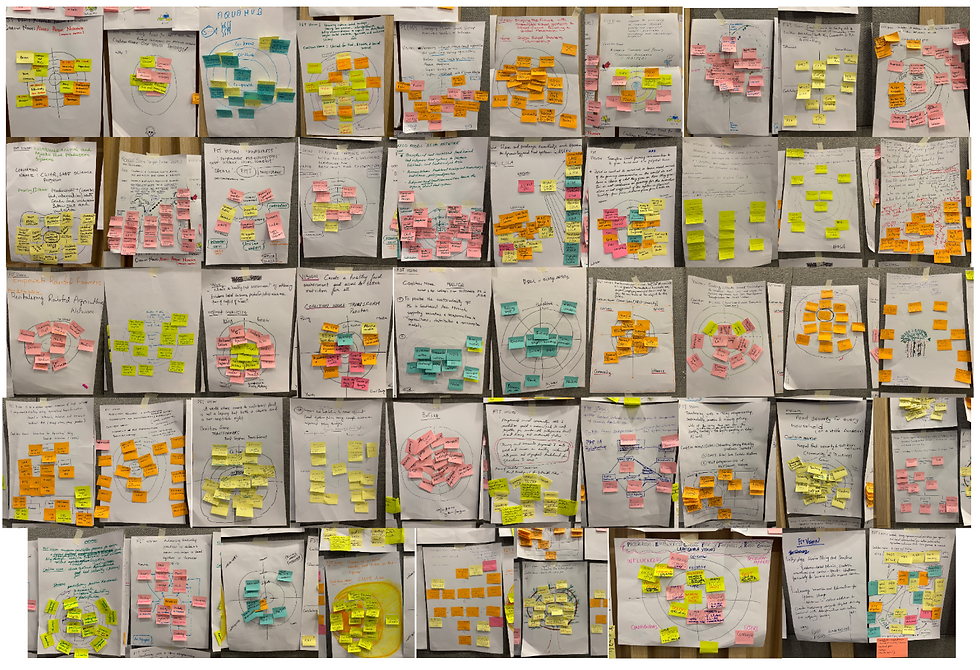
In mapping what such collaboration would require, participants identified recurring blind spots: financing actors, legal and governance expertise, communication roles, and stronger bridges between grassroots actors and decision-makers.
For us, this reinforced an important lesson: collaboration work is not simply about bringing people together, but helping groups better understand the wider system they are trying to influence.
By the final day, the energy in the room had shifted. Participants were no longer only analysing barriers; they were designing pathways forward.

They wrote recommendations to policymakers, funders, researchers, and regional institutions. They made personal commitments. They identified conversations worth continuing and partnerships worth exploring.
That matters, because convenings like this should not be endpoints. Done well, they create the conditions for longer-term collaboration and shared ownership.
What we’re taking away
This workshop reinforced something we see often in complex systems work: transformation rarely stalls because people don’t care.
More often, it stalls because systems are fragmented, incentives are misaligned, and collaboration across boundaries is harder than it sounds.
Bringing the right people into a room is only the beginning. The deeper work lies in designing processes that help people move from parallel efforts toward shared ownership, from analysis toward action, and from disconnected initiatives toward something larger than any one organisation can achieve alone.
Sometimes, the most valuable outcome is not a new initiative.
It’s helping existing efforts work as part of a larger shared effort.


Comments